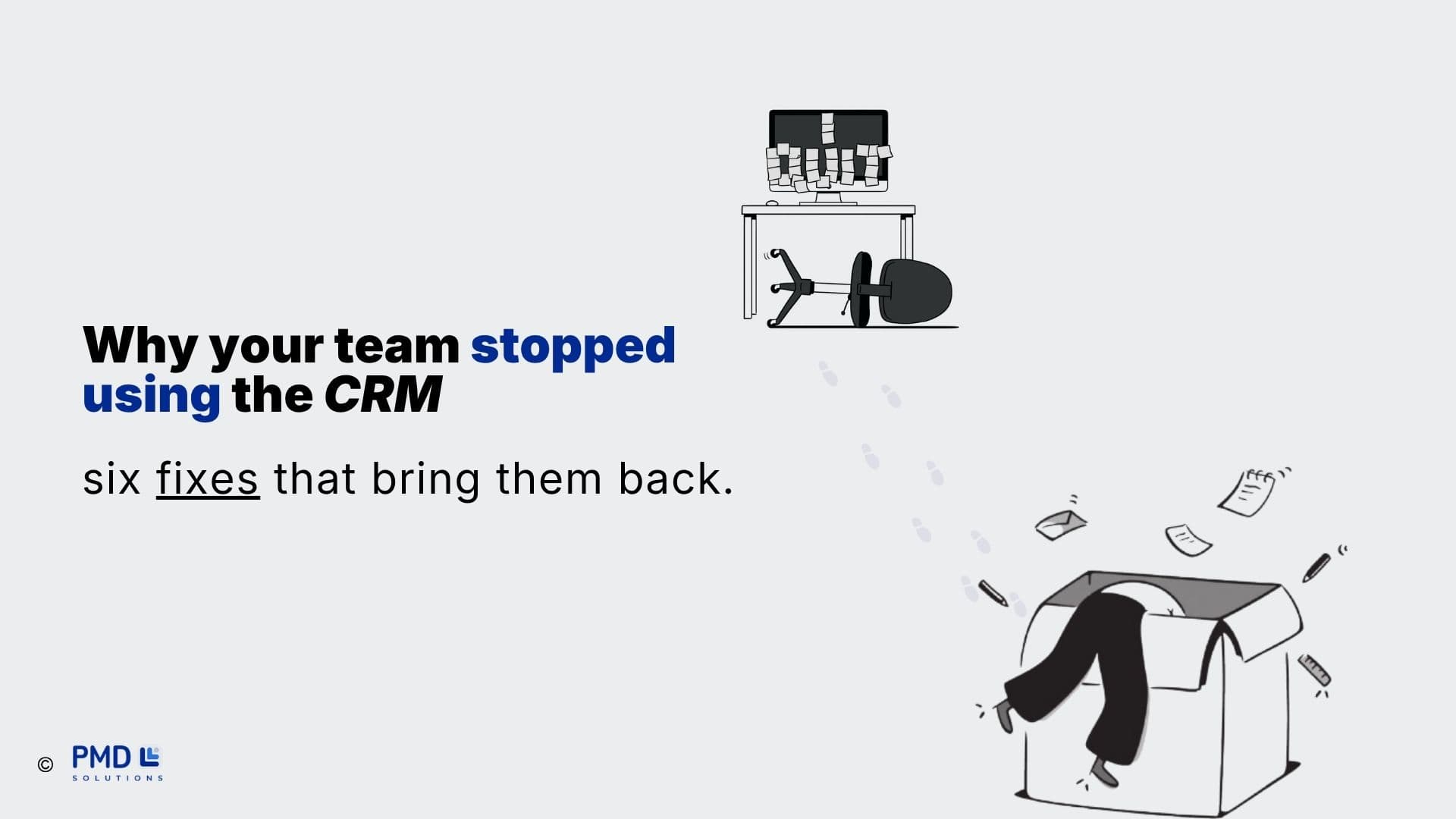
You bought the CRM. You imported the data, built the pipeline, and ran the training session. Three months later, deals live in spreadsheets, call notes live in Slack, and the weekly pipeline meeting starts with "let me check with the team."
This is rarely a people problem. Your team isn't lazy or resistant to change. They're avoiding a tool that costs them time and gives little back. CRM adoption fails for a short list of predictable reasons, and each one has a fix.
Why Teams Stop Using the CRM
It's extra work. Reps enter data that helps managers and reports, but nothing that helps them sell.
Too many required fields. A simple lead takes 25 fields and five minutes to log.
Nobody trusts the data. Records are outdated and duplicated, so people stop looking at them, and stop updating them.
Leadership doesn't use it. If forecasts come from a spreadsheet, the CRM is optional.
Nobody owns it. No one fixes problems, so small annoyances become reasons to quit.
1. Show Each Role What They Get
"Better visibility" is a benefit for the boss. Each role needs its own reason to care:
Sales reps: a clear daily task list, full contact history before every call, no manual follow-up tracking.
Marketing: proof of which campaigns produce real deals, not just leads.
Support and account managers: the full customer story in one place, so customers never repeat themselves.
Managers: pipeline reviews without chasing updates.
Pick one workaround each team uses today and show how the CRM does it faster.
2. Cut Fields and Steps
Go through every required field and ask: who uses this, and what decision does it support? If there's no answer, remove it or make it optional. Then shorten what's left:
Use dropdowns and default values instead of free text.
Connect email and calendar so calls, emails, and meetings log themselves.
Show only the fields that matter at each pipeline stage.
If logging a call means opening three tabs, it won't get logged.
3. Make the CRM the Only Source of Truth
This is the strongest adoption lever you have, and it costs nothing. Set one rule: if it isn't in the CRM, it didn't happen.
Run pipeline reviews and forecast meetings directly from CRM dashboards.
Don't accept status updates from spreadsheets or chat messages.
Have leaders use the CRM themselves, visibly, every week.
4. Automate the Busywork
Every manual step you remove is one less reason to skip the CRM. Start with the tasks your team complains about most:
Automatic lead assignment and round-robin routing
Follow-up tasks created when a deal changes stage
Reminders for deals with no activity in 7 days
Contact and company data filled in automatically
5. Train on Workflows, Not Features
A two-hour walkthrough of every menu doesn't stick. Teach the five things each role does daily, using their real deals and accounts.
Keep sessions short and role-specific.
Record 2-minute how-to videos for common tasks.
Include the CRM in onboarding for every new hire on day one.
6. Assign an Owner and Track Usage
Someone must own the CRM: fix issues, answer questions, and collect feedback. Then measure a few simple signals each month:
Percentage of open deals with a next step and close date
Number of deals with no activity in 14+ days
Activities logged per rep per week
Completeness of key fields
Ask the team for their top three frustrations every month, and fix them. Nothing builds trust faster than a complaint that gets resolved.
A 30-Day Adoption Plan
Week 1: Interview users from each team. List what slows them down.
Week 2: Remove unneeded fields and fix confusing pipeline stages.
Week 3: Automate the top three manual tasks and run role-based training.
Week 4: Move pipeline reviews into the CRM and start tracking usage metrics.
Where Teams Get Stuck
Some adoption problems can't be solved with a rule or a training session. They sit in how the CRM was built:
Messy data left over from a migration
Disconnected tools that force double entry
Workflows that don't match how your team sells
No one in-house with the time or skills to manage the system
You can fix these yourself, and many teams do. But if the CRM has been underused for months, an outside review often finds the cause faster than another round of internal reminders.
Paying for a CRM nobody opens?
PMD Solutions is a HubSpot Platinum Partner. We simplify CRM setups, automate manual work, and connect your tools, so your team has a reason to use the system every day.