Both B2B and e-commerce teams say their CRM is “hard.” But they’re rarely talking about the same problem.
In B2B, “hard” usually means complex accounts, long sales cycles, multiple stakeholders, and messy handoffs between sales, marketing, and finance. In e-commerce, “hard” usually means thousands of customers moving through non-linear behaviors, fragmented identities, and a stack of tools that don’t agree on who the customer is or what stage they’re in.
Most articles and vendor pages blur this distinction. They rank Salesforce, HubSpot, and Pipedrive alongside Klaviyo and Omnisend as if they solve the same job. That leads to bad buying decisions, frustrated teams, and CRM projects that stall not because the software is “wrong,” but because it was chosen for the wrong sales motion.
This article breaks down why ecommerce CRM deployment feels hard for a different reason than B2B, and what that means for your CRM implementation challenges around data migration and integration, growing team adoption, change management and training, and process and workflow customization.
B2B vs e-commerce: different CRM implementation challenges by design
B2B CRM: accounts, deals, and pipelines
B2B CRMs are built around the account (company) and the deal (opportunity), not just a person. The core objects are accounts, contacts, opportunities, tasks, meetings, and quotes. The system assumes a sales rep is having multi-week or multi-month conversations with a prospect, logging calls, and pushing a deal through stages from “discovery” to “closed-won.”
Average contract values are high—$5,000, $50,000, $500,000—and volume is low. Reporting focuses on win rate, sales cycle length, and rep productivity. Pricing is per seat, because you’re paying for the salesperson’s tooling.
The complexity comes from:
Managing multiple stakeholders per account
Tracking long, non-linear deal progress across stages
Aligning sales, marketing, and finance around one source of truth
The UI, data model, and workflows assume low volume, high value relationships. That’s why B2B CRMs feel “hard”: they’re modeling complex organizational buying, not high-frequency transactions. [6]
E-commerce CRM: customers, orders, and events
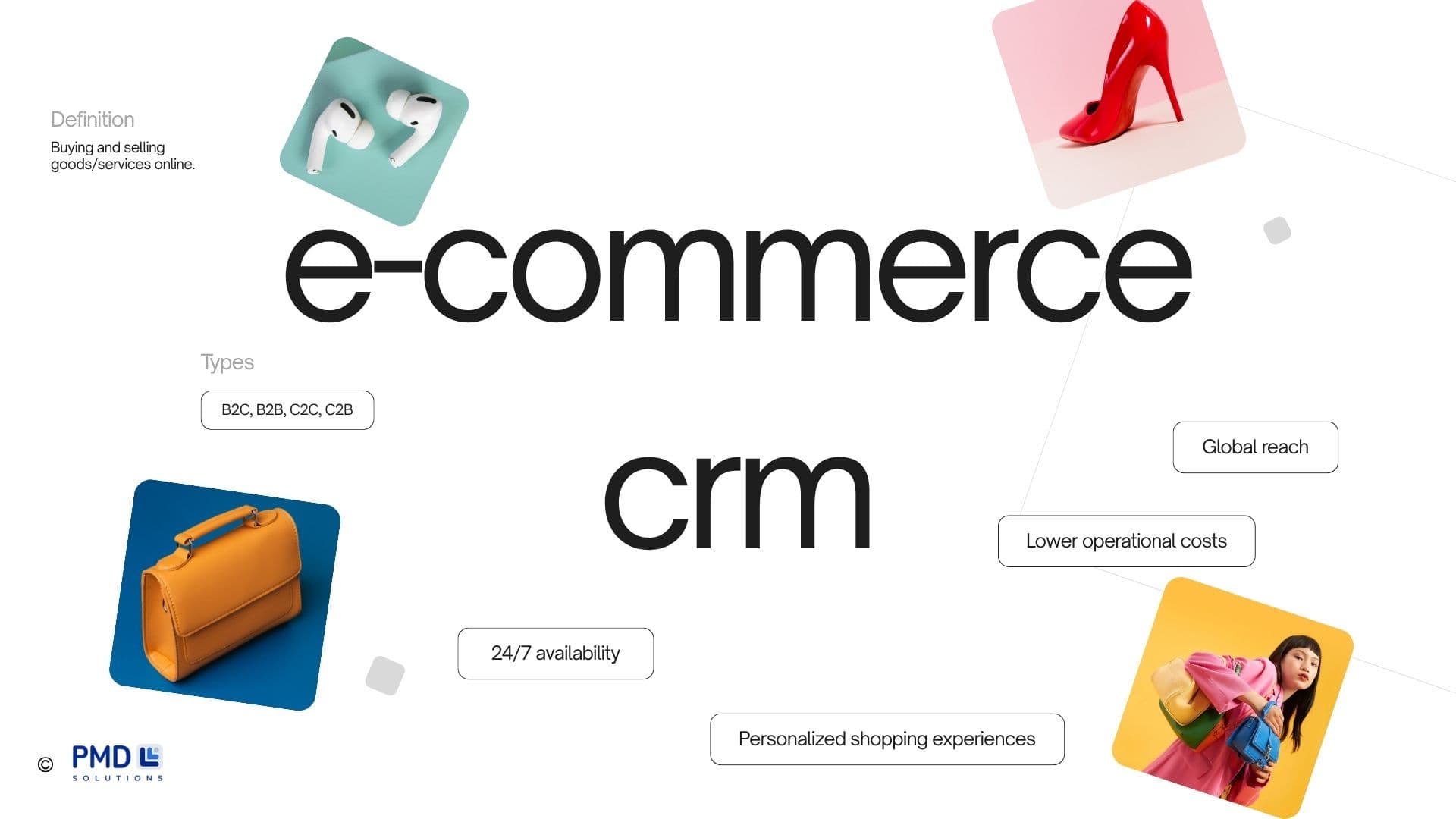
E-commerce CRMs are built around customers, orders, products, and behavioral events: views, carts, purchases, returns. Core objects include customer/profile, order, product/SKU, cart, and an event stream (browse, add-to-cart, purchase, refund). The system is optimized for high-volume, short-cycle, post-purchase relationships.
Pricing is per contact, per send, or per message—never per seat. A 50,000-contact Klaviyo account costs the same whether one person or twenty use it, because the cost driver is the volume of customer relationships, not the labor of managing them.
From working with retail teams, the real difficulty isn’t the number of transactions but the variety of customer states a CRM must track and act on: browsing vs purchasing, first-time vs repeat, full-price vs promo-driven, loyal vs deal-seeker, online vs in-store identity, handling returns and re-purchases.
Unlike B2B, a customer’s state can change daily or even hourly, and the CRM must adapt in real time. This is a different kind of hardness: modeling dynamic behavior at scale, not managing a stable set of accounts.
E-commerce CRM success depends on treating behavior as events (views, searches, purchases, churn signals) rather than static segments. Rigid lifecycle rules break when SKU structures, channels, or promotions shift; event-driven logic is more resilient. That’s why many operators describe e-commerce CRM as a lifecycle engine that reacts to real-time behavior, not a static sales pipeline built for deal stages.
The four failure domains in ecommerce CRM deployment
Ecommerce implementations rarely fail because the software is “wrong.” They stall when store data, support queues, wholesale pipelines, and marketing consent collide without clear ownership. In 2026, the stack is denser—Shopify or Woo plus ESP, helpdesk, payments, returns, and AI assistants—so a weekend CSV import is not a rollout.
Four patterns show up again and again:
Identity debt — guest checkout, multi-brand stores, and email typos create duplicate contacts before day one.
Integration theater — a Zap or native connector “works” until refunds, partial shipments, or SLA breaches go silent.
Tool-first training — teams learn click paths, not the three jobs they do every day (lookup customer, log issue, hand off wholesale).
Unshared process — sales and support invent stages, tags, and side sheets because the CRM never matched how ecommerce actually sells and serves.
Treat these as workstreams with named owners—not a single “CRM project” owned only by IT.
1. Data migration and integration: move rules, not just rows
Ecommerce migrations fail when you import history without match keys, consent rules, or a freeze window. Design the identity model before any bulk load. This is the heart of data migration and integration risk in ecommerce CRM deployment.
Step-by-step
Define match keys — normalize email; store Shopify/Woo customer IDs on the contact; decide how guest → account merges work.
Assign system of record per field — store owns shipping/order facts; CRM owns lifecycle, owner, sales notes, and support disposition.
Separate transactional history from marketing contacts — import purchase history for CRM/CS visibility; gate marketing lists on consent and recent engagement so license costs and compliance don’t explode.
Map refunds, cancellations, and partial shipments — net revenue and VIP segments must reflect reality, not GMV.
Pilot one brand or segment — validate sample records (duplicates, LTV, open tickets) before company-wide cutover.
Freeze, delta-import, dual-run — freeze writes, load deltas, keep the old system read-only 30–90 days with a named person who can pause syncs. [10]
Prevention checklist
Match keys and merge rules written before sync
One-page field ownership map (store vs CRM)
Refund/cancellation properties in the data model
Brand/store key if you run multi-store portals
2. Integrations: monitored handoffs, not fragile glue
In 2026, “we connected Shopify” is not done. Load-bearing syncs need owners, retries, alerts, and idempotent webhooks. Prefer a native connector, Make/n8n, or a custom API with monitoring over undocumented one-off Zaps. This is where data migration and integration turns from a one-time project into an ongoing operational discipline.
Step-by-step
Inventory every tool that touches the customer — store, CRM, ESP, helpdesk, payments, returns, ERP/finance.
Draw direction of truth — one-way where possible; bidirectional only with field-level ownership.
Prioritize three syncs for go-live — contact/customer identity, order + refund events, and support ticket context. Everything else is phase two.
Add failure alerts — Slack/email when syncs fail or drift; name an owner for each load-bearing flow.
Test unhappy paths — refunds, address changes, wholesale quotes, and ticket reopen—not only new orders.
3. User adoption: train the jobs, not the product tour
Licenses fill while work stays in the store admin and inbox. Adoption dies when cutover is declared after sync, not after people can do their jobs in the CRM. This is the core of growing team adoption and change management and training.
Step-by-step
Name the three daily jobs per team — sales (qualify wholesale, advance deal, log next step); support (find buyer + order, log issue, escalate); marketing (segment on consented, clean data).
Role-based training in the cutover week — 45–60 minutes per role on those jobs only; skip feature tours.
Appoint champions — one sales lead and one support lead who can answer “where does this go?” without opening a ticket to IT.
Watch unused seats and shadow sheets for two weeks — unused logins and side spreadsheets are leading indicators of failure.
Require CRM for handoffs — wholesale deals and escalations that skip the CRM get bounced back. Process enforcement beats another reminder email.
4. Process standardization: one lifecycle for sales and support
Scaling teams collapse when DTC lifecycle, wholesale pipeline, and support SLAs live in three mental models. Clone the old CRM’s stages and reps invent sheets again. This is where process and workflow customization makes or breaks the rollout.
Step-by-step
Rewrite how work actually moves — ignore default CRM stages for one workshop; map subscriber → first buyer → repeat → VIP and wholesale inquiry → quote → closed-won.
Define stage exit criteria — not vibes. “Qualified” means budget, volume, and brand fit recorded—not “had a call.”
Align support queues to the same identity — ticket views pull order status and VIP flags from CRM properties owned by the store sync.
Standardize required properties — short list only: brand/store, lifecycle stage, owner, last order date, open ticket count. Expand when the team asks.
Document routing once — who owns wholesale vs DTC vs returns escalations.
Publish a one-page operating rhythm — weekly pipeline + queue review; monthly data hygiene (duplicates, blank owners, stale deals).
A 90-day ecommerce CRM rollout sequence
Use this as a default plan for mid-size to large teams. Compress only if identity and process are already clean. This sequence directly addresses the main CRM implementation challenges in ecommerce.
Days 1–15 — Discovery and design
Process workshop, field ownership map, match keys, lifecycle redesign, integration inventory.Days 16–45 — Build and pilot
Portal/pipelines/properties, core syncs with alerts, pilot one brand or segment, champion training.Days 46–60 — Cutover
Freeze, delta import, dual-run, role-based training, enforce CRM handoffs.Days 61–90 — Stabilize and scale
Kill shadow sheets, add phase-two automations, hygiene reviews, expand reporting for sales and support leaders.
Skipping discovery to “save time” usually buys a second migration six months later.
What “good” looks like after go-live
After a solid ecommerce CRM deployment, you should see:
One buyer → one primary contact, with store customer ID and clear merge history
Sales and support open the same record and trust order + lifecycle data
Refunds and cancellations don’t inflate VIP segments or revenue dashboards
Sync failures alert a named owner within hours, not weeks
Wholesale and DTC stages have exit criteria; side sheets are empty
Unused seats trend down; CRM is required for escalation and deal handoff
If you only fix three things, fix these: identity/dedupe, system of record, and monitored integrations. Adoption and process stick once those hold.
Quick prevention checklist for CRM implementation challenges
Use this as a final sanity check before and during your rollout:
Match keys + merge rules before any bulk import
Field-level system of record (store vs CRM)
Refunds/cancellations in the model
Monitored integrations with named owners
Lifecycle redesigned for how you actually sell (DTC + wholesale)
Role-based training in the cutover week
CRM-required handoffs for sales ↔ support
Dual-run / rollback plan for 30–90 days
FAQ: ecommerce CRM implementation
How long does an ecommerce CRM implementation take?
For mid-size to large teams with an existing store and helpdesk, plan 60–90 days from discovery to stable dual-run. Simpler single-brand stacks can move faster; multi-store and ERP-linked catalogs take longer.
Should we migrate all historical orders into the CRM?
Migrate enough history for support and LTV decisions—not every line item into marketing. Keep transactional buyers distinct from marketing contacts unless consent and engagement justify it.
HubSpot or another CRM for ecommerce?
Pick the CRM your GTM and support teams will live in, then design identity and sync around the store. HubSpot is a strong fit when marketing, sales, and service need one portal; the implementation discipline above matters more than the logo on the login screen.
When should we bring in an implementation partner?
Bring help when you have multi-brand identity issues, ERP/finance sync, or a failed first attempt with shadow sheets. A partner should deliver match keys, monitored syncs, and adoption—not only portal configuration.
Next step
Map your current stack against the four domains above. If identity, sync ownership, or sales/support process is unclear, book a free call and we’ll sketch a cutover plan you can run with your team—or with us.
Book a free call · Ecommerce migration pitfalls · CRM implementation